| |
Jan 15, 2024 - We are all sold out of chestnuts from the 2023 harvest
season.
The Washington Chestnut Company offers fresh
chestnuts for sale at
BuyFreshChestnuts.com right from the
farm in northwest Washington State. Orders can be shipped to anywhere in the
USA, including California. Chestnuts grown in Northwest Washington experience
a cool growing season resulting in sweeter chestnuts, just like the chestnuts
from the mountains in Spain, Portugal, France and Italy. The cool growing
season also has the
chestnut trees hold on to the nuts much longer than warmer growing areas.
Later falling chestnuts is good for you because the chestnuts will not have
been in cold storage for weeks, giving you the freshest chestnuts possible.
We use best practices methods to manage the orchard and the delivery of the
fresh chestnuts to you. Our most important best practice is to help you enjoy
chestnuts to their fullest. We look forward to being your chestnut farm of
choice when you are in the market for fresh chestnuts.
Enjoying fresh chestnuts in your diet is a great choice. Chestnuts are low in
fat, gluten free, high in fiber, and they taste great. It is hard to find a
better tasting food item than fresh chestnuts. Chestnuts are also a very
versatile ingredient for many types of dishes aside from just eating it fresh
from the roaster. From soups to salads, main dishes, and even deserts,
chestnuts can be a part of each and every one. To get started using chestnuts
in your culinary dishes, order some chestnuts right from the farm where the
chestnuts are grown by placing your order today.
Chestnut News
February 8, 2019 - Chestnut Tree Pollen in Orchards
Its taken many years of observations to collect enough data and casual
research to bring some sense to what is happening in chestnut orchards when
the orchards are in bloom. The article
"Chestnut Pollen Guide" provides chestnut orchardists and those planning a
new orchard specifics understanding pollen in chestnut orchards.
August 25, 2018 - A new class of Hybrid Chestnut Tree -
Washington Chestnut Company and several other organizations has been evaluating
a new chestnut cultivar known as Szego. The Szego chestnut tree has many traits
supporting the needs for both the commercial grower and the home orchardist.
For growers east of the Rocky Mountians, their wish list would consist of these
traits: Easy to grow, upright growth, excellent nuts set, chestnuts with
excellent flavor and texture, the nut is easy to peal, and chestnut blight and
phytophthora resistance. The Szego achieves these wish items in addition it
also is an excellent pollen producer and the nut size is very large. Unlike
Chinese grafted chestnut trees, the Szego does not usually drop the graft under
stress conditions.
There is still lots of breeding work to be done to add more chestnut tree
cultivars to the options for chestnut growers. "Many Thanks", goes out to all
those involved in the breeding efforts of chestnut trees.
September 17, 2017 - Dealing with Winter Damage in the Chestnut Orchard
Winter can be some difficult times for chestnut trees. The good thing about
winter in the chestnut orchard is there are almost no bugs chewing on the new
growth. The bad thing is the cold can damage or even kill the trees.
Read more about how harmful winters can be.
January 2, 2017 - Winning the Battle of Phytophthora in a Chestnut
Orchard
One of the most devastating sicknesses for a chestnut tree is phytophthora. In
a single growing season, a health chestnut tree can contract phytophthora,
slide into poor health and die.
Read more about phytophthora and chestnut trees.
February 19, 2016 - N in the Forecast
This article looks at data associated with the application of nitrogen (N) in
chestnut orchards. Nitrogen is one of the most important nutrients in the soil
and has the most impact on the performance of chestnut trees.
Supplemental Nitrogen in Chestnut Orchards. A must read for anyone, hobby
or commercial chestnut producer.
November 9, 2014 - Selecting a Chestnut Cultivar
The perfect chestnut tree for one chestnut producer may not be the perfect
chestnut tree for someone else. How does someone just starting out with their
initial planning a commercial chestnut farm get started? This article titled
"Chestnut Tree Perfection: The Selection of a
Cultivar" is a great place to start.
October 10, 2014 - Evaluating a New Cultivar
We propagate so many chestnut trees one would think we would come across a
chestnut tree that produces better chestnuts than the parents. Almost all the
cultivars we have in our inventory are "large and sweet" so to get a chestnut
that is better than what is already available is a long shot. This year we do
have a new tree worth giving more attention to. While evaluating this new tree
we will give it a name of Aywonko (A 1 ko). Beyond the sweet and large, this
chestnut has a great traditional European texture and a great chestnut flavor.
On the down side, this year the nuts are difficult to peel. We will keep
Aywonko around for a few years to see if the difficulty in peeling goes away
with the age of the tree.
August 10, 2013 - Making Super Star Chestnut Trees
Remember those days when we were kids, we would say things like, "I want to be
a movie star", "I want to be a fireman", "I want to be a model", "I want to be
anything as long it is something special". Most chestnut trees are born from a
seed resulting in what we call a seedling. Being called a "seedling" doesn't
sound like something special, especially when we call some of the super
stars...
Read the entire Making Super Stars article
January 13, 2013 - Grouping and Sorting Chestnut Tree Cultivars
Selecting chestnut trees for your orchard can be a daunting task with so many
different chestnut tree cultivars to choose from. This article might help you
find the perfect selection for your orchard by grouping chestnut trees by
some of the characteristics chestnut orchardist use to select their chestnut
trees. Grouping Chestnut Trees
Washington Chestnut Company is a producer of fresh chestnuts from its orchard
operations and chestnut trees from its nursery operations. The nursery
operations offers over 30 named chestnut cultivars to commercial chestnut
producers, retail garden and nursery centers, and direct sales to the public.
|
|
|
|
Online Orders
Orders for fresh chestnuts and chestnut trees can be made online on our
e-store BuyFreshChestnuts.com
Storing Chestnuts for Weeks
We developed a process of cleaning and sanitizing chestnuts you can do for
yourself so the chestnuts do not rot during storage for up to 8 weeks post
harvest.
Storing Chestnut for Weeks
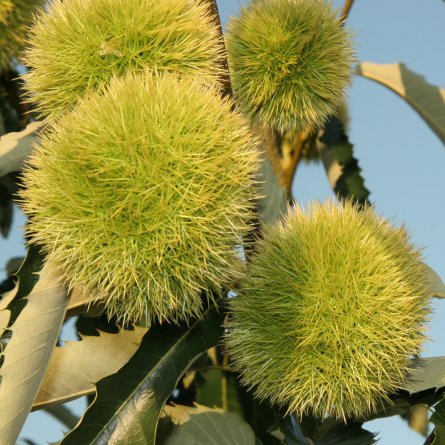
Chestnut burrs nearing harvest time
Blight Resistant American Chestnut Trees
Over the years people have called asking if we have the kind of American
chestnut trees that is blight resistant. After consulting with the experts we
have decided we will not propagate these trees. The primary reason is the seed
and plant tissues would have to come from the Eastern USA where there are bad
bugs, blight, and a few other things we never want to see in our orchards. The
only place to get these trees is from the American Chestnut Foundation.
Taking Chestnuts into Canada
Residents of Lower British Columbia are allowed under USMCA to bring fresh
chestnuts produced in Washington state to Canada. We work closely with the
Ag inspectors to make sure our chestnuts meet all requirements to allow you to
enter Canada with fresh chestnuts. If you would like to pick up some fresh
chestnuts from us please call ahead so we can have your order
ready for you when you arrive. Our phone number is (360) 592-3397.
What to do with chestnuts
Chestnuts are an incredible food item. Some people eat them raw, but most
eat them cooked, kind of like potatoes. We all have heard of people who will
eat a potato raw. Well there are people who eat chestnuts raw too. Chestnuts
must be stored properly between the time the chestnuts are harvested to the
time the chestnuts are consumed. For details about the important handling,
preparing and cookng of chestnuts see our page on
storing and preparing chestnuts.
Contact Information:
Washington Chestnut Company
6160 Everson Goshen Rd.
Everson, WA 98247
Ph: (360) 592-3397
Email: chestnuts.wa@gmail.com
|
|
 Home
Home